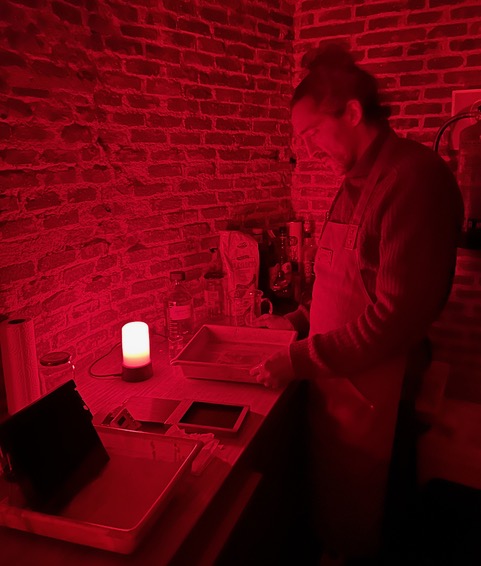
Achim Boers working in the darkroom during a wet plate collodion workshop

Wet Plate Collodion

Two-day workshop

← All workshops

The workshop

Make a photograph on glass

Pour the collodion, work with the camera and watch a photograph appear in the developer. A wet plate image carries the marks of how it was made. This weekend is an opportunity to take part in that whole process, with guidance at each stage.

I will show you how to prepare a plate, judge the exposure and finish the image, while explaining the chemistry that makes it possible. There is time to make photographs, look closely at your results and try again with a better understanding of what to change.

Ask about the next workshop
Duration
2 days
Format
Usually a weekend
Teaching approach
Practical work supported by science
With
Achim Boers

What you’ll make

Your own wet plate photographs, with practice in preparing, exposing and finishing each plate.

What you’ll learn

  • Understand the differences between ambrotypes, tintypes and glass negatives.
  • Prepare and clean a plate, pour collodion and sensitise it for exposure.
  • Work with the camera and light to make a wet plate photograph.
  • Develop, fix and wash the image, and understand the purpose of each stage.
  • Learn how to dry, varnish and care for a finished plate.
  • Recognise chemical hazard labels and practise safe handling and darkroom technique.

Two-day programme

Day 1

The process and your first plates

Begin with the materials and chemistry, then put that understanding into practice at the camera and in the darkroom.

  • History, image types and an introduction to the chemistry.
  • Equipment, protective measures and preparing a clean glass plate.
  • Coating, sensitising and exposing a plate.
  • Developing, fixing and washing your first images.

Day 2

Practice, control and finishing

Repeat the workflow with more attention to the result, and learn how to finish and protect the image.

  • Further plate-making and camera practice.
  • Exploring exposure and development through the plates you make.
  • Creative approaches to portraits and still-life photographs.
  • Final washing, drying, varnishing and care of the finished plate.

The science

Why the process works

We examine the roles of silver salts, light and the developing and fixing solutions. The aim is to understand what each stage contributes to the image and why the sequence matters.

The practical work gives you a way to connect those explanations to what you see on the plate. You will consider how preparation, exposure and processing affect your results.

The history

Archer and the wet plate process

In 1851, Frederick Scott Archer introduced the wet plate collodion process. A photographer could make a detailed image on a glass plate, but had to coat, expose and develop it before it dried. The darkroom became part of the act of taking a photograph.

That close relationship between preparation and picture-making is still at the heart of the process. We look at ambrotypes, tintypes and glass negatives, then use the same underlying principles to make photographs today.

Join a workshop

Contact me for upcoming dates, locations and availability.

Enquire about this courseBack to workshops