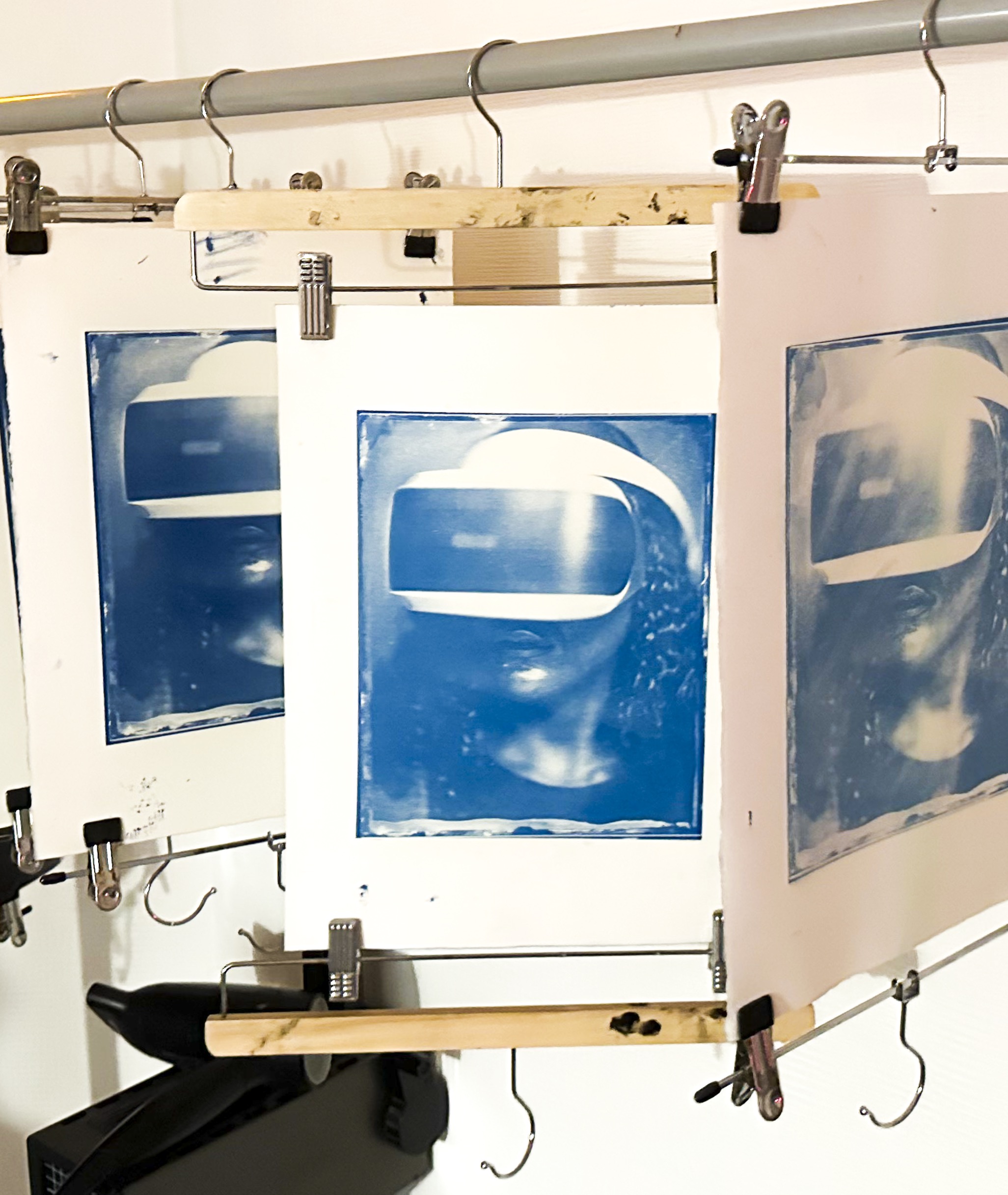
Cyanotype photographs hanging to dry in the studio

Cyanotype

Two-day workshop

← All workshops

The workshop

Print in blue, then explore toning

A sheet of paper, a photographic image and light: cyanotype makes the act of printing visible. Over two days, you will learn to prepare and print an image, then explore what happens when you begin to change its familiar blue through toning.

Day one gives you a working foundation in cyanotype and in creating digital negatives. On day two, we turn to toning. I will explain the chemistry as we work, so that the changes in your prints become something you can understand and explore further.

Ask about the next workshop
Duration
2 days
Format
Basics, digital negatives and toning
Teaching approach
Practical work supported by science
With
Achim Boers

What you’ll make

Cyanotype prints from digital negatives, followed by toning experiments to compare colour and tonal changes.

What you’ll learn

  • Understand the origins of cyanotype and its place in photographic practice.
  • Learn the role of the sensitising chemistry and how to handle the materials carefully.
  • Prepare paper and work through exposure, washing and drying.
  • Create digital negatives for cyanotype printing.
  • Explore toning and compare its effects on a print.
  • Connect the appearance of your prints to the chemistry and choices involved in making them.

Two-day programme

Day 1

Cyanotype basics and digital negatives

Build a foundation in cyanotype printing and prepare digital negatives to use in the process.

  • A short history and an introduction to the materials and chemistry.
  • Preparing paper and understanding the printing workflow.
  • Creating digital negatives for contact printing.
  • Making prints, reviewing exposure and evaluating the results.

Day 2

Toning and the chemistry of toning

Explore how toning changes a cyanotype and learn to connect the visual result with the underlying chemistry.

  • An explanation of the chemistry of toning.
  • Practical toning experiments with cyanotype prints.
  • Comparing changes in colour and tonal appearance.
  • Reviewing your results and discussing choices for further printing.

The science

Why the process works

The course explains the role of iron-based chemistry and light in cyanotype printing. We connect that explanation to the practical work of preparing paper, exposing a print and evaluating the image.

On the second day, the focus moves to the chemistry of toning. We use the prints and experiments to discuss why their appearance changes, so you can make informed creative choices.

The history

Herschel and Anna Atkins

John Herschel developed cyanotype in 1842 through his experiments with light and chemistry. The following year, Anna Atkins began publishing cyanotype images of algae, using the process to bring botanical specimens onto the page.

Their work connects scientific observation with a very direct way of making an image. In this course, digital negatives open that process to your own photographs, while toning gives you further choices about the finished print.

Join a workshop

Contact me for upcoming dates, locations and availability.

Enquire about this courseBack to workshops